Patty Weeks remembered when computers were first brought into K-12 classrooms three decades ago.
“I was probably one of the first people to even get a computer at Stockton,” said Weeks, who has worked to educate teachers for nearly 30 years as the director of the university’s Southern Regional Institute and Educational Technology Training Center (SRI & ETTC). “There was so much anxiety. Teachers were saying, ‘I’m going to lose my job if I don’t learn how to do this.’”
Today, Weeks notices similar sentiments among teachers with the emergence of artificial intelligence.
“There’s a lot of fear about AI now and trying to educate the educators about how AI can be positive,” she said. “These are the tools they will be using in their future.”
Workshops on how to integrate AI into a classroom are part of the Computer Science Coastal Hub at the SRI & ETTC, which was created three years ago with funding from the state Department of Education. Earlier this year, Stockton received a $280,000 grant to continue to train teachers on the implementation of mandatory state computer science standards.
The state has awarded more than $1.5 million to Stockton’s hub since 2022 and more than 800 teachers have taken part in free computer science workshops, Weeks said. Several of the workshops this summer included topics such as data visualization, coding with drones and game design.
Elementary school teachers Joann Case and Deepa McCabe are regular attendees of the Stockton workshops, and they were both excited when one on AI and machine learning was offered this summer.
“I work with really young students who are going to be impacted by AI for the rest of their lives,” said Case, a K-4 technology teacher at Endeavor Elementary School at Joint Base McGuire-Dix-Lakehurst. “I wanted to see how I can make that relatable to an early elementary student. How can they get a base of understanding of it? What is machine learning? How can AI impact their future? Basically, what is it? They may have preconceived notions of what it is.”
McCabe, a computer science teacher and librarian in the Ocean City School District, sees the potential for positive uses of AI in the world. “I think that teaching students how to be the creators of the tech that has positive uses, rather than just consumers, helps them understand it more and where it could go wrong,” McCabe said.
But as a parent to high-school aged children, she also has seen some of the dangers of students just using AI as a shortcut to get schoolwork done. “I’ve definitely had concerns as a parent,” she said.
One of the workshop’s most interesting lessons didn’t even use a computer. The “unplugged” exercise simulated how AI machines learn. One teacher would train another teacher acting as AI on how to recognize the difference between shapes and animals. One teacher would show the other a flash card of either an animal or a fruit. The teacher acting as AI would then have to place the card in one of those two categories.
“But sometimes you were given an example that wasn’t a shape or an animal, and you still had to put it one of those two categories,” McCabe said. “When you do an example like that with kids, it makes them start to understand that AI is going to give you an answer, even if it’s the wrong answer. Its answer is only based on the data that has already been provided to it.”
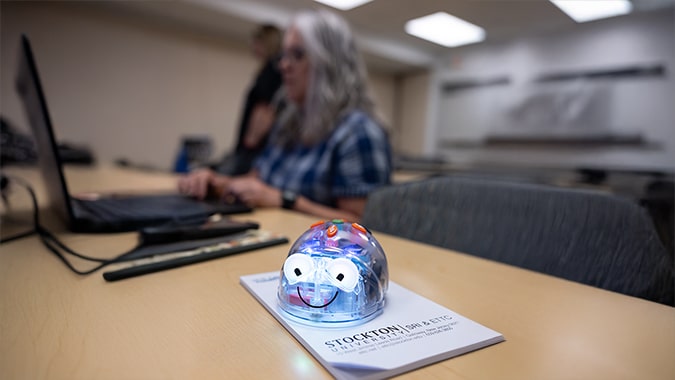
In addition to the free workshops, the hub also offers lesson plans for teachers, the opportunity to network and get ideas from peers and a free lending library offering tools for all ages, such as programmable robots, Chromebook tablets and books on coding.
For Case, attending the workshops are all about trying to stay current. “Technology is not like a core subject where the material doesn’t change. Every day there’s something new,” she said. “I want to leave the workshop with resources and lesson plan ideas and more tools in my teacher toolbox to meet the growing needs. “That’s my biggest goal with my students: I want them to see themselves as the programmers of the future.”
Learn more about the Coastal Hub for Computer Science by visiting the program’s website and also see a schedule of upcoming events. For questions or more information, contact Weeks by email at patty.weeks@stockton.edu.
Photo caption: Bluebots are a type of robot that teachers can learn how to program during computer science workshops. – Image courtesy of Stockton University.