
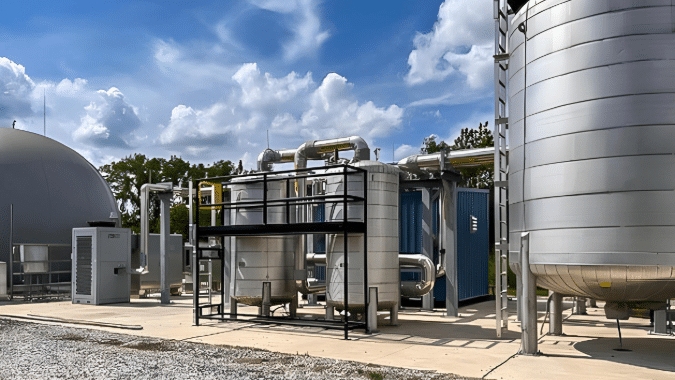
The Gloucester County Utilities Authority recently completed the installation of a combined heat and power system, which is being financed with approximately $14 million in loans from the NJ Water Bank, a low-rate funding program jointly administered by the New Jersey Department of Environmental Protection and the New Jersey Infrastructure Bank (I-Bank).
Because this project addresses energy and water efficiency goals, it is eligible for $2 million in principal forgiveness. The total savings for this project, including PF and lower interest costs, is estimated to be $8,319,897 over the 30-year term of the loan, or 60% of the total project costs as compared to the authority financing it independently.
"This project represents a major step forward for our county," said Gloucester County Board of Commissioners Director Frank DiMarco. "By turning waste into clean energy, we're not only cutting costs at the wastewater treatment facility but also reducing our environmental footprint.
“None of this would be possible without the support of the New Jersey Water Bank, whose partnership makes it easier for communities like ours to invest in resilient, sustainable infrastructure. Together, we're protecting ratepayers from rising energy prices and ensuring a cleaner, stronger future for generations to come."
In addition, this project created an estimated 166 direct single-year construction jobs.
A CHP system runs on a fuel source, often natural gas, biogas, or even methane captured from the wastewater treatment process to generate electricity through a turbine or engine. Biogas produced during the digestion process is captured and refined through a gas conditioning system and then used to fuel a combustion engine connected to 1,000 KW power-generating units.
Unlike traditional power plants, which waste much of the heat they produce, a CHP system captures that heat and puts it to work for things like heating buildings, drying solids from sewage, or powering the treatment process.
More energy is produced from the same fuel, resulting in less waste and lower costs. This efficiency is particularly important in the water treatment industry which requires a lot of energy. Innovative facilities like the GCUA are proving that proactive investment in alternative energy pays off for budgets, ratepayers and the planet.
The electricity generated by the GCUA CHP will directly power the wastewater treatment facility, significantly reducing reliance on the electrical grid.
With this system in place, the GCUA anticipates operating at, or near net-zero energy.
This project was designed by Remington Vernick Engineers and constructed by Pioneer Pipe Contractors, Inc., Scalfo Electric, Inc., and Eastern Environmental Contractors.