
U.S.-based employers announced 85,979 job cuts in August, up 39% from the 62,075 announced in July, according to a recent report from the global outplacement and business and executive coaching firm Challenger, Gray & Christmas.
The report says the greatest number of announced job cuts, which includes employees offered early retirements, are occurring in these six industries: pharmaceutical, financial services, retail, nonprofit, technology, and media & news.
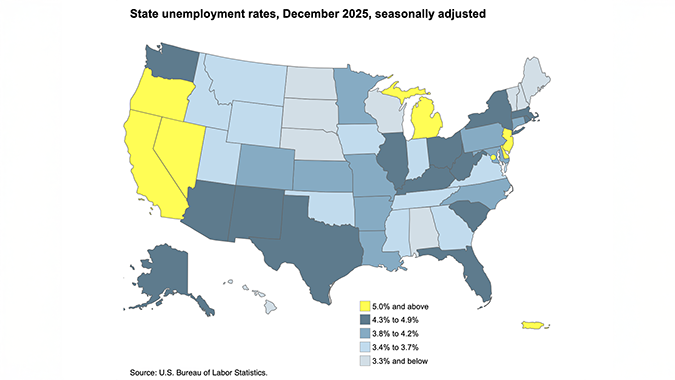
The eastern U.S. has experienced the largest year-over-year increase in job cuts, rising 224% from 147,368 in 2024 to 477,092 in 2025. This surge is driven by reductions at federal agencies counted in Washington, D.C., where cuts jumped from 34,526 last year to 294,696 this year. The report said New Jersey posted the sharpest state-level increase, climbing 697% from 7,754 to 61,760, while New York rose 33% from 59,114 to 78,440.
August’s nationwide total was the highest for the month since 2020 when 115,762 job cuts were recorded, the report said. After 2020, it is the highest August total since the thick of the Great Recession in 2008, when 88,736 cuts were announced.
Viewed on a year-over-year basis, job cuts overall are up 13% compared to the 75,891 job cuts that were announced in August 2024. Last month marks the sixth time in 2025 that the job cut total surpassed that of the corresponding month one year prior.
“After the impact of DOGE on the federal government, employers are citing economic and market factors as the driver of layoffs. We’ve also seen a spike in cuts due to operation or store closings and bankruptcies this year compared to last,” said Andrew Challenger, Senior Vice President and labor expert for Challenger, Gray & Christmas.
The Industries Where the Most Job Cuts Are Happening
Pharmaceutical companies announced plans to cut 19,112 jobs in August, for a total of 22,433. This is an increase of 142% from the 9,254 cuts in this sector during the same period last year, the report said. The pharmaceutical industry is facing increasing competition as patents expire, while also refocusing on higher-profit products. Many of these companies are also implementing AI, leading to restructuring and job loss.
Financial firms announced 18,092 job cuts in August for a total of 44,986, up 27% from 35,526 cuts announced through August 2024. “Economic uncertainty and market volatility have increased pressure on companies in finance to tighten belts,” Challenger said.
Retailers have announced 83,656 job cuts through August, up 242% from the 24,489 cuts announced during the same period last year. “Retailers are being hard hit by tariffs, inflation, and ongoing economic uncertainty causing bankruptcies and closures. If tariffs and consumer spending constraints play out, the approaching holiday shopping season may see fewer seasonal hires and, in fact, high layoffs,” said Challenger.
Nonprofits announced 4,325 job cuts last month for a total of 22,151. This is an increase of 449% from the 4,032 job cuts announced in the first eight months of 2024. It is also the most job cuts for the sector since 2020.
Technology continues to be a leading job-cutting industry in August with 12,988. While it trails only the government in announced job cuts this year with 102,239, the cuts in this sector are down 3% from the 105,426 cuts announced during the same period last year.
Media companies, which include streaming services and studios, have announced 13,729 job cuts so far in 2025. That is up 13% from the 12,122 cuts announced during the same period last year. This increase has not been felt in the news industry, which Challenger tracks as a subset of media. Through August, news organizations have announced 1,547 cuts, half of the 3,102 cuts announced in the same period last year.
Reasons for Job Cuts
“DOGE Actions” remains the leading reason for job cut announcements in 2025, cited in 292,279 planned layoffs so far this year. This includes direct reductions to the federal workforce and its contractors and the “DOGE downstream impact” such as the loss of funding to private nonprofits and affiliated organizations.
Market and economic conditions are the second-most cited reason for workforce reductions, followed by closing of stores and plants, business restructuring, bankruptcies, and technological updates, including automation and AI.