
After nearly a decade of painstaking research, a new tomato variety is ready for its moment in the sun.
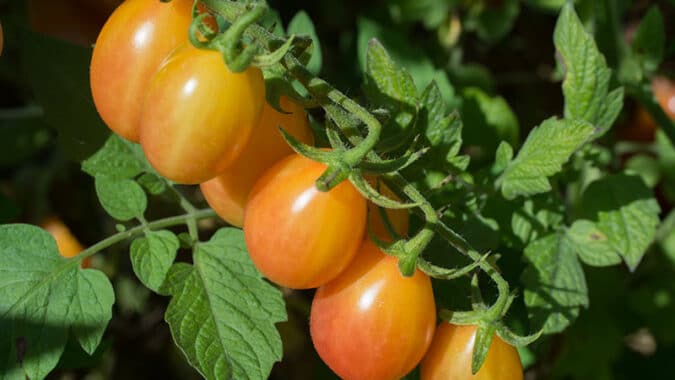
“Scarlet Sunrise,” a bicolor grape tomato developed through a long collaboration between Rutgers researchers Peter Nitzsche and Tom Orton, is a sweet, crack-resistant tomato with a golden hue and a reddish blush.
The new tomato variety, developed through traditional breeding methods at Rutgers University, will be featured at the Open House and Tomato Tasting event on Aug. 27 at the university’s Clifford E. and Melda C. Snyder Research and Extension Farm in Pittstown.
“This is a great example of how our innovative Rutgers scientists collaborate with New Jersey industries to conduct research that serves communities throughout the state and region,” said Josh Kohut, dean of research at Rutgers’ School of Environmental and Biological Sciences.
Nitzsche and Orton trace ‘Scarlet Sunrise’s’ origins to 2012, when they noticed promising traits in two very different tomatoes. Could the best traits of one, a commercial red grape tomato known for its flavor, be combined with the second, a bicolor cherry tomato which was sweet but prone to cracking open as it grew?
“We saw potential in both,” said Nitzsche, an associate professor and agricultural agent for Rutgers Cooperative Extension. “So, we crossed them, hoping to combine the firmness of the grape with the flavor and color of the bicolor.”
The process of finding a plant with the best combination of characteristics was anything but simple. Because red is a dominant trait, early generations showed no sign of the desired bicolor. It took years of backcrossing, which is a technique used to introduce or reinforce a specific trait, as well as field trials and lab analysis to isolate the right combination of traits.
“There were times we thought it wouldn’t work,” said Nitzsche, who also is director of the Snyder research farm. “Everything was red. No bicolor. That’s when you get frustrated.”
The breeding process was physically challenging, too. “It’s hard to crossbreed grape tomatoes because their flowers are tiny and fragile,” said Orton, now an emeritus professor of plant biology.
In a painstaking process that extended over months, then years, Orton used tiny tweezers to extract parts from hundreds of plants to stop them from self-pollinating and tiny paintbrushes to dab other plants’ pollen on them.
Eventually, the team succeeded. The university has ensured that the intellectual property rights of “Scarlet Sunrise" are shielded by the U.S. Department of Agriculture as “plant-variety protected.”
“Scarlet Sunrise” was meant to be officially released in 2020, but its emergence occurred just as the COVID-19 pandemic disrupted seed distribution. Now, with the university actively seeking seed partnerships with commercial growers, the tomato is poised to reach a wider audience.
In a market dominated by mass production, New Jersey growers face stiff competition from California and Mexico. But Jersey tomatoes have the edge on flavor, and ‘Scarlet Sunrise’ delivers, said Nitzsche.
“We’ve always tried to focus on flavor as the competitive advantage for New Jersey growers,” he said. “It doesn’t have to be perfect-looking. It just has to taste great.”
The tomato’s balance of sugar and acid makes it ideal for snacking – and its distinctive appearance helps consumers recognize it in the market.
“It’s yellowish with a reddish blush,” Nitzsche said. “One of our colleagues looked at it and said, ‘That looks like a sunrise,’ and the name stuck.”
The Open House and Tomato Tasting event offers members of the public a chance to sample ‘Scarlet Sunrise’ alongside dozens of other varieties, including heirlooms, hybrids and experimental breeds. The event includes wagon tours, educational displays and support from Rutgers Master Gardeners, who help harvest and serve the fruit.
The event is open rain or shine from 1 p.m. to 7 p.m. on Wednesday, Aug. 27, but tickets must be purchased in advance for all guests 13 and over. The Snyder Research and Extension Farm is at 140 Locust Grove Road in Pittstown, Hunterdon County.
To purchase tickets in advance, go here. No walk-ins will be permitted on the day of the event.